Long Predicted Atomic Collapse State Observed in Graphene: Berkeley Lab researchers recreate elusive phenomenon with artificial nuclei
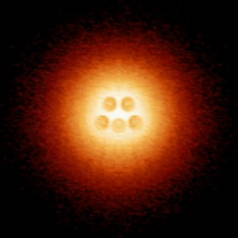
An artificial atomic nucleus made up of five charged calcium dimers is centered in an atomic-collapse electron cloud.
NASA Rover Finds Conditions Once Suited for Ancient Life on Mars

Two Different Aqueous Environments
This set of images compares rocks seen by NASA's Opportunity rover and...
NASA Pinpoints Causes of 2011 Arctic Ozone Hole

Maps of ozone concentrations over the Arctic come from the Ozone Monitoring...
Herschel gets to the bottom of black-hole jets

Artist's impression of the GX 339-4 black-hole binary system.
Breaking the final barrier: room-temperature electrically powered nanolasers
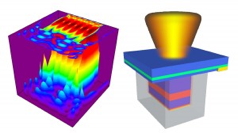
The illustration on the left shows the variations of light intensity within a nanolaser. The figure on the right shows schematically a...
High-performance, NW-OPTs open the way for optoelectronic device miniaturization

Schematic diagram of single-crystalline nanowire organic phototransistors
Blue Bursts of Hot Young Stars Captured by Hubble
Temp-controlled 'nanopores' may allow detailed blood analysis

By tethering gold nanoparticles (large spheres in top image) to the nanopore (violet), the temperature around the nanopore can be changed...