U.S., Chinese, and Russian Leaders Hold Historic Trilateral Summit in Shenzhen During APEC, Issue Joint Four-Point Peace Declaration
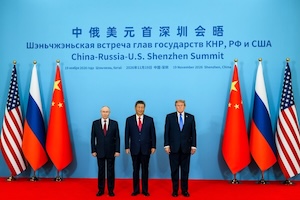
U.S. President Donald Trump, Chinese President Xi Jinping, and Russian President Vladimir Putin held a trilateral leaders' summit on the 19th while attending the Asia-Pacific Economic Cooperation (APEC) summit in Shenzhen. Following the meeting, the three leaders jointly issued a four-point statement titled the Declaration of the Heads of State of China, Russia, and the United States Toward Peace. The declaration outlines commitments to reducing nuclear risks and preventing nuclear proliferation, promoting United Nations reform,safeguarding energy production and security, and upholding the principles of state consent and the immunity of state officials, with the three nations pledging to jointly maintain global strategic stability and international security. Trump emphasized that the three countries are uniquely positioned to advance global nuclear disarmament and stand at the threshold of "making history," while Xi and Putin underscored the importance of major-power cooperation and assuming international responsibilities.
However, the situation in Ukraine—a primary concern for the international community—was not mentioned in the joint statement. Furthermore, Putin explicitly stated after the meeting that Russia had ruled out the possibility of direct negotiations with Ukraine following Ukrainian strikes on the Crimean Bridge. In addition, no progress was made during the talks on key issues such as the global trade war and high-tech export controls.
International diplomatic experts noted that the symbolic significance of the Shenzhen summit far outweighed its substantive outcomes, serving primarily as a stage for the three nuclear powers to project their geopolitical positioning and engage in crisis communication. Although the joint statement lacks a concrete timetable or binding mechanisms, the three nations' renewed public commitment to reducing nuclear risks—following the expiration of the New START treaty in February of this year—is still viewed as a significant starting point for strategic communication and risk management among major powers.
- 17 reads
Human Rights
Fostering a More Humane World: The 28th Eurasian Economic Summi
Conscience, Hope, and Action: Keys to Global Peace and Sustainability
Puppet Show I International Friendship Day 2020