White House Confirms Trump, Xi and Putin to Hold Trilateral Meeting in Shenzhen on Nov. 19
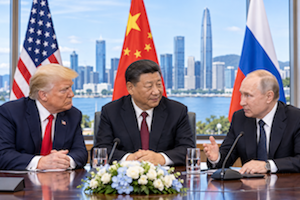
The White House confirmed on Nov. 13 that U.S. President Donald Trump, Chinese President Xi Jinping and Russian President Vladimir Putin are expected to hold a trilateral meeting in Shenzhen, China, on Nov. 19. The meeting would mark the first trilateral summit among the leaders of the world's three major nuclear powers. They are expected to exchange views on global nuclear arms reductions, the conflict involving Iran and broader international security issues, drawing widespread international attention.
According to reports by the Associated Press and The Washington Post, the White House has confirmed plans for the trilateral meeting, which is expected to take place during Trump's visit to China and coincide with events related to the Asia-Pacific Economic Cooperation (APEC) forum. White House Assistant Press Secretary Olivia Wales said Trump hopes to use the opportunity to discuss global nuclear arms reductions with Xi and Putin and reduce the risks posed by nuclear proliferation.
U.S. officials said one of the key topics will be how to establish a new nuclear arms control framework involving the United States, Russia and China. However, officials acknowledged that no concrete agreement should be expected from the first meeting. The immediate priority is to establish channels of dialogue and lay the groundwork for future nuclear negotiations.
Global nuclear arms control is facing new challenges. The New Strategic Arms Reduction Treaty (New START), the last major nuclear arms control agreement between the United States and Russia, expired in February 2026. Its expiration means that, for the first time in more than half a century, the two countries no longer have a legally binding agreement limiting their strategic nuclear arsenals. Trump has advocated a new and more comprehensive nuclear arms control agreement and hopes to bring China into the framework.
China, however, has remained cautious about joining nuclear arms reduction negotiations. According to estimates by the U.S. Department of Defense, China currently possesses more than 600 nuclear warheads, far fewer than the more than 5,000 held by each of the United States and Russia. Beijing argues that the nuclear arsenals of Washington and Moscow are significantly larger than China's, making it unfair to require all three countries to participate in the same arms reduction framework.
In addition to nuclear issues, the conflict involving Iran is also expected to feature prominently in the discussions. The ongoing confrontation between the United States and Iran continues to affect the Middle East and global energy markets, while China and Russia maintain varying degrees of political, economic and strategic ties with Tehran. Trump hopes that direct talks with Xi and Putin could help reduce the risk of further escalation and provide a clearer understanding of Beijing's and Moscow's positions on Iran.
As for the Russia-Ukraine war, Putin has long sought to engage with Trump in pursuing a ceasefire arrangement favorable to Moscow. However, U.S. officials have indicated that Ukraine is not the primary focus of the trilateral meeting. Ukrainian President Volodymyr Zelenskyy has expressed concern over the possibility that the three major powers could discuss the future of the war without Ukraine's participation, potentially sidelining the country's national interests and security arrangements.
Analysts say the meeting carries not only significant military and security implications but also considerable political symbolism. For Xi, bringing the three leaders together in Shenzhen would help demonstrate China's growing influence in global diplomacy. For Putin, sitting at the same table with the leaders of the United States and China would reinforce Russia's status as a major global power and help counter its long-standing diplomatic isolation from the West.
Nevertheless, the three countries remain deeply divided over nuclear policy, the Russia-Ukraine war and the situation in the Middle East, making a substantive agreement in the near term difficult. International observers are also watching whether the meeting could unsettle U.S. allies in Europe and Asia. Ukraine and Taiwan, in particular, may be concerned that the three major powers could reach new understandings affecting regional security without the participation of the parties directly involved.
The rare trilateral summit is expected to become one of the most closely watched diplomatic events surrounding the APEC meetings. Although it may not produce immediate breakthroughs, whether the leaders of the three major powers can use direct dialogue to reduce nuclear risks, ease tensions in the Middle East or even create new diplomatic opportunities for ending the Russia-Ukraine war could have far-reaching implications for the future of global geopolitics.
- 11 reads
Human Rights
Fostering a More Humane World: The 28th Eurasian Economic Summi

Conscience, Hope, and Action: Keys to Global Peace and Sustainability

Puppet Show I International Friendship Day 2020