Political Tensions Escalate in Poland as Riot Police Enter Constitutional Court
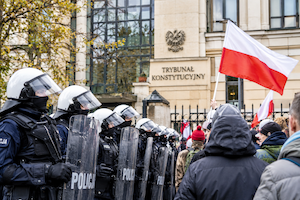
Poland has been engulfed in a serious political and judicial confrontation in recent days, as the pro-European government led by Prime Minister Donald Tusk and the conservative camp of President Karol Nawrocki clash over judicial appointments and control of the Constitutional Tribunal. Following the suspension of the tribunal's president, protests erupted in Warsaw, prompting police to deploy riot officers around the court to maintain order. Tensions continued to escalate, forcing Nawrocki to cut short his visit to Africa and return urgently to Warsaw.
According to foreign media reports, the political crisis intensified on October 30. Several Constitutional Tribunal judges backed by the current parliamentary majority announced the suspension of tribunal President Bogdan Święczkowski and Vice President Bartłomiej Sochański. Senior judge Anna Korwin-Piotrowska was appointed to assume their responsibilities. Święczkowski previously served under the former government led by the conservative Law and Justice (PiS) party, and his suspension immediately triggered a strong backlash from conservative forces.
Following the announcement, hundreds of opposition supporters and members of parliament gathered outside the Constitutional Tribunal to protest. Police deployed riot officers and imposed security restrictions around the building. Some demonstrators attempted to breach security barriers and threw objects at police officers. Authorities said three people had been arrested. The situation briefly became tense. Police emphasized that their deployment was intended to maintain public safety and order, rather than take control of the court's internal operations.
President Nawrocki had originally been scheduled to make an official visit to Senegal. However, after learning of the confrontation at the court, he abruptly returned to Warsaw and personally visited the Constitutional Tribunal. Footage from the scene showed him near a police cordon, where he became involved in a physical confrontation with officials while attempting to enter the court building. Nawrocki subsequently criticized the government's actions, accusing it of undermining constitutional order and attempting to forcibly take over a state institution. He also called for security forces to withdraw.
Meanwhile, Prime Minister Tusk defended the government's position and the actions of the judges involved, stressing that Poland must restore the rule of law and judicial independence. He accused the previous Law and Justice government of allowing political interference in the judicial system during its time in power. Tusk said that although the reform process could involve controversy, the government had a responsibility to ensure that the Constitutional Tribunal operated in accordance with the constitution.
The latest confrontation is rooted in Poland's long-running dispute over judicial reform. Between 2015 and 2023, when the Law and Justice party was in power, the government introduced a series of judicial reforms that repeatedly sparked disputes with the European Union over judicial independence. After Tusk's government returned to power in 2023, it pledged to reform the judicial system. However, its efforts have faced resistance from the conservative president and opposition forces. Disagreements over appointments to the Constitutional Tribunal have remained particularly contentious.
The situation has been further complicated by Nawrocki's earlier refusal to administer the oath of office to five new judges elected by parliament, preventing them from taking up their positions. The Venice Commission, an advisory body under the Council of Europe, stated this month that the president's refusal to administer the oath should not prevent the judges from assuming office. Nevertheless, significant disagreements remain over the tribunal's composition and the eligibility of its judges.
As of November 1, Nawrocki had held emergency consultations with representatives of several political parties. However, the Civic Coalition, to which Tusk belongs, refused to attend, and the talks failed to produce a breakthrough. The European Commission urged the president to accept the appointments of the new judges, while the U.S. ambassador to Poland publicly called on all parties to exercise restraint and prevent the confrontation from escalating further.
Analysts say the Constitutional Tribunal has become more than just the center of an internal dispute over judicial appointments. It is now a focal point of the broader power struggle between Poland's president and government. With the 2027 parliamentary elections approaching, the standoff could further deepen social divisions and test Poland's democratic institutions, judicial independence, and relationship with the European Union.
- 4 reads
Human Rights

Fostering a More Humane World: The 28th Eurasian Economic Summi

Conscience, Hope, and Action: Keys to Global Peace and Sustainability
Puppet Show I International Friendship Day 2020