Japan to Strengthen Self-Defense Force Coordination, Plans to Use U.S. AI to Bolster Cyber Defense
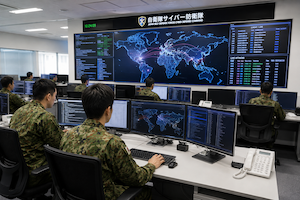
The Japanese government has begun considering the introduction of artificial intelligence (AI) capable of accessing the source servers from which cyberattacks are launched and neutralizing their ability to cause harm. Japan’s Ministry of Defense also plans to introduce software in 2027 for equipment operated by the Air Self-Defense Force, including radar systems and fighter jets, to detect and block cyberattacks.
As advanced AI systems with powerful vulnerability-detection capabilities, such as Claude Mythos, emerge, concerns are growing that such technology could be exploited maliciously to launch cyberattacks. In response, the Japanese government plans to use advanced AI with comparable capabilities to strengthen the country’s cyber defense.
Yoichi Iida, Japan’s Cabinet Cybersecurity Officer at the National Cybersecurity Office, said the government formally decided at a Cabinet meeting in March to implement the relevant system starting October 1. He stressed that the use of AI in active cyber defense is inevitable. While measures to neutralize the ability of attackers to cause harm are being considered, he said the government has entered a phase of studying how to automate responses, on the condition that humans remain involved in making final decisions.
Meanwhile, the Ministry of Defense is accelerating related measures to prevent disruptions to critical functions and maintain deterrence.
Amid increasingly sophisticated cyberattacks, the new measures are designed to detect anomalies in individual pieces of equipment in real time and prevent damage from spreading. The system is expected to be gradually expanded to other types of equipment.
The software will assign each individual device a tamper-resistant electronic ID for authentication, clearly distinguishing legitimate equipment from counterfeit devices using stolen or falsified identities.
The software will also monitor the activity of each device. If it detects unauthorized external access or a virus intrusion, it will automatically cut off communications to prevent damage from spreading from a single device to surrounding systems. Communications will be strictly limited to the minimum necessary connections, making it more difficult for attackers to infiltrate the network.
Over the next five years, AI systems are expected to become a key element in transforming Japan’s defense capabilities to adapt to new forms of warfare. The Self-Defense Forces have not yet adopted AI for command and control, but the government is considering introducing multiple AI systems to support operational decision-making.
However, the use of AI systems would require the Self-Defense Forces to provide classified information, raising concerns over whether foreign companies could gain access to sensitive data. To mitigate these risks, the Japanese government hopes eventually to replace foreign technologies with domestically developed AI systems.
- 169 reads
Human Rights

Fostering a More Humane World: The 28th Eurasian Economic Summi

Conscience, Hope, and Action: Keys to Global Peace and Sustainability


Puppet Show I International Friendship Day 2020