Japan and India Deepen Strategic Partnership, Reach Three Key Agreements at Summit
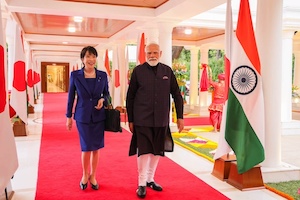
Japanese Prime Minister Sanae Takaichi made her first visit to India since taking office, meeting with Indian Prime Minister Narendra Modi in New Delhi on July 2. Speaking at a joint press conference after the summit, Takaichi revealed that Modi affectionately referred to her as his "beautiful younger sister." The two leaders agreed to address each other as brother and sister going forward, with Takaichi saying she would work hand in hand with her "elder brother" Modi to usher Japan–India relations into a new phase.
According to Japanese media reports, the 90-minute meeting produced consensus on three major areas: deepening the Japan–India strategic partnership, strengthening economic and energy security, and expanding cooperation in investment and technological innovation. The two leaders also confirmed that their foreign and defense ministers would convene a "2+2" meeting later this year. As China continues to expand its military influence in the region, Japan and India also agreed to jointly advance an upgraded vision of a "Free and Open Indo-Pacific" (FOIP 2.0).
Takaichi's visit forms part of the reciprocal "shuttle diplomacy" between Japanese and Indian leaders and marks the first visit to India by a Japanese prime minister since 2023. Following the summit, the two sides released a joint outcomes document covering economic security and artificial intelligence (AI) cooperation, underscoring their commitment to deepening strategic ties.
Strengthening cooperation with India in defense and economic affairs was a central objective of Takaichi's trip. For Japan, which has actively promoted the Free and Open Indo-Pacific strategy, India remains a key partner in its Indo-Pacific framework. At the press conference, Modi stated that building a "free, prosperous, and rules-based Indo-Pacific region" is a shared priority for both countries.
Takaichi said the two nations had agreed to expand maritime security cooperation, including advancing joint exercises between the Japan Maritime Self-Defense Force and the Indian Navy, enhancing cooperation on naval vessel maintenance, and promoting defense equipment collaboration. She added that both governments had instructed their officials to hold the Japan–India "2+2" ministerial meeting within this year.
On economic and energy security, Takaichi announced that Japan and India would strengthen the resilience of critical supply chains, establish a bilateral dialogue mechanism on India's strategic petroleum reserves, and support India's bid to join the International Energy Agency (IEA). Japan will also assist India in constructing 1,000 biogas facilities and support collaborative projects involving renewable energy and ammonia production.
In the area of investment and industrial cooperation, Takaichi announced that Japanese and Indian companies signed approximately 120 cooperation agreements during the visit, covering sectors such as semiconductors and artificial intelligence. The agreements represent total private-sector investments of around ¥2 trillion (approximately NT$400 billion), bringing Japan closer to its government target of ¥10 trillion in cumulative investment in India.
India is also a member of the Quadrilateral Security Dialogue (Quad). Having now completed visits to the United States, Australia, and India, Takaichi hopes this summit will further strengthen momentum for cooperation within the Quad framework.
- 220 reads
Human Rights
Fostering a More Humane World: The 28th Eurasian Economic Summi

Conscience, Hope, and Action: Keys to Global Peace and Sustainability
Puppet Show I International Friendship Day 2020