Iran launches heavy bombing; the United Arab Emirates announces the closure of its airspace.
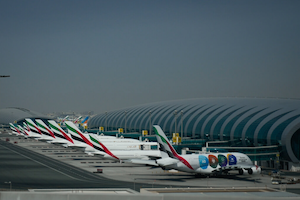
The United Arab Emirates (UAE) announced on the 17th that, in response to a new wave of missile and drone attacks launched by Iran, the government has taken “special precautionary measures,” including the immediate and temporary closure of the country’s entire airspace to ensure aviation safety and national sovereignty.
The UAE’s General Civil Aviation Authority (GCAA) stated that the decision was made after a comprehensive assessment of regional security conditions and aviation operational risks, and that coordination had been completed with relevant domestic and international authorities. Officials emphasized that ensuring the safety of flights and crew, as well as safeguarding territorial sovereignty, are the top priorities at present.
Tensions in the Middle East have escalated rapidly. Iran has recently carried out large-scale airstrikes against multiple targets in the region, prompting heightened alert among neighboring countries. The UAE government announced at the earliest opportunity that, based on national security considerations, it would fully close its airspace and suspend all civilian and commercial inbound and outbound flights to prevent further escalation from affecting domestic security.
According to reports, Iran’s military operation targeted several facilities considered to have strategic value. Although officials have not disclosed a detailed list of targets, multiple countries in the region have already raised their military alert levels. Analysts suggest the move may be linked to rising geopolitical tensions, particularly over energy routes and military deployments, which have intensified frictions between Iran, Western nations, and some Arab countries.
In a statement, the GCAA described the airspace closure as a “precautionary measure” and stressed that it will continue to monitor developments and adjust restrictions as necessary. Major airports within the UAE, including Dubai International Airport and Abu Dhabi International Airport, have suspended flight operations, affecting a large number of travelers, while airlines have activated emergency response mechanisms.
Experts note that the Middle East has long been a key hub for global energy supply, and any escalation of conflict could trigger ripple effects on international oil prices and the global economy. Market volatility has already begun to emerge, with investors showing increased risk aversion.
As of the time of writing, Iran has not issued a direct response to the UAE’s airspace closure. However, regional tensions continue to rise. There are widespread concerns that, without effective mediation mechanisms, the conflict could further expand, with far-reaching consequences for the Middle East and the broader global landscape.
- 107 reads
Human Rights

Fostering a More Humane World: The 28th Eurasian Economic Summi

Conscience, Hope, and Action: Keys to Global Peace and Sustainability

Puppet Show I International Friendship Day 2020