Voyager 1 Reaches One Light-Day Distance from Earth 49 Years After Launch
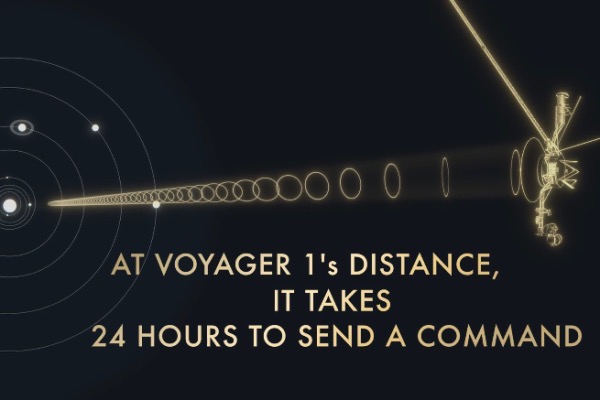
NASA’s deep-space probe Voyager 1 has set another milestone in space exploration! Launched in 1977, the spacecraft has traveled continuously for nearly 49 years and reached a distance of approximately 26 billion kilometers from Earth on November 18, U.S. Eastern Time. This is equivalent to the distance light travels in 24 hours, making Voyager 1 the first human-made object to reach the one-light-day milestone.
NASA said Voyager 1 crossed this distance threshold at around 5:16 a.m. local time. Because radio signals travel at the speed of light, it takes approximately one day for commands sent from Earth to reach the spacecraft, and another day for its responses to return. This means a round-trip communication takes roughly two days. The achievement not only highlights the probe’s extraordinary distance from Earth but also underscores the communication challenges facing deep-space missions.
Voyager 1 is continuing its journey at approximately 60,000 kilometers per hour. It left the heliosphere, the region shaped by the Sun’s solar wind and magnetic field, and entered interstellar space in 2012. Its original mission was to conduct close-up observations of Jupiter, Saturn, and their surrounding environments. Since then, it has continued transmitting scientific data from interstellar space. Its twin spacecraft, Voyager 2, launched in the same year, also entered interstellar space in 2018 and is expected to reach the one-light-day distance from Earth around 2035.
However, both spacecraft face the challenges of declining power supplies and aging equipment. Voyager 1 relies on electricity generated by the radioactive decay of nuclear material. In recent years, the engineering team has gradually shut down some power-consuming instruments to extend the spacecraft’s limited operational life. NASA estimates that current power-saving measures will allow both probes to maintain communication with Earth for another three to four years.
In addition, Voyager 1 carries the Golden Record, which contains sounds, music, images, and greetings in multiple languages from Earth, serving as a record of human civilization sent into the cosmos. Even when its power is eventually depleted and it can no longer transmit messages, the spacecraft will continue along its current trajectory, traveling farther into the vast reaches of interstellar space.
- 17 reads
Human Rights
Fostering a More Humane World: The 28th Eurasian Economic Summi

Conscience, Hope, and Action: Keys to Global Peace and Sustainability


Puppet Show I International Friendship Day 2020