Japan Launches MMX Mars Probe, Aiming to Return Moon Samples in 2031
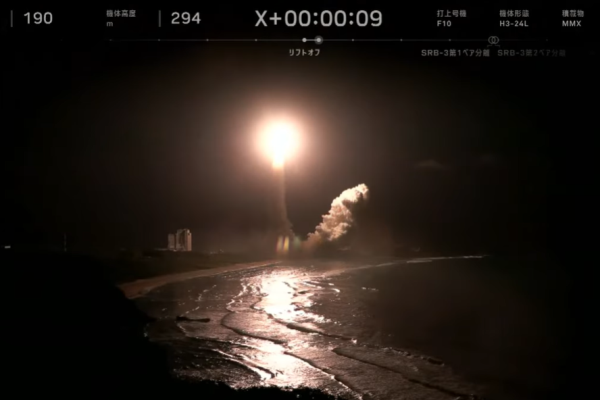
Japan Aerospace Exploration Agency (JAXA) successfully launched an H3 launch vehicle carrying the Martian Moons eXploration (MMX) spacecraft at 4:41 a.m. Japan time on October 20 (3:41 a.m. Taiwan time the same day). The rocket lifted off from the Tanegashima Space Center in Kagoshima Prefecture. About an hour later, MMX successfully separated from the rocket and officially began its journey toward the Martian system. The mission aims to collect material from a Martian moon and return it to Earth, seeking to accomplish the world's first mission of its kind.
MMX is expected to arrive near Mars around August 2027, with its primary target being Phobos, the larger of Mars' two moons. Located approximately 6,000 kilometers from the Martian surface, Phobos has a diameter of about 22.5 kilometers and orbits Mars roughly three times a day. The spacecraft will also observe the other moon, Deimos, collecting data on the terrain and environmental conditions of both bodies.
During the mission, MMX will carry IDEFIX, a small rover jointly developed by France and Germany, to investigate the surface environment of Phobos and identify suitable landing sites for the spacecraft. MMX will subsequently collect surface samples, aiming to obtain at least 10 grams of rock and soil before beginning its return journey to Earth. The samples are scheduled to arrive in 2031. The returned materials and associated data will enable scientists to analyze the composition and formation history of Mars' moons.
The origins of Phobos and Deimos remain uncertain, with several competing explanations. One hypothesis suggests that a large celestial body once struck Mars, ejecting material that eventually accumulated to form the moons. Another theory proposes that both moons were originally asteroids later captured by Mars' gravity. By analyzing the mineral composition and chemical characteristics of the collected samples, researchers will be able to evaluate these theories and potentially deepen their understanding of the early evolution of the solar system.
Beyond fundamental scientific research, the mission will also test technologies for approaching, landing on and collecting samples from low-gravity celestial bodies. Because Phobos is relatively close to Mars, JAXA also hopes to assess whether it could serve as a potential support base for future Mars exploration, providing valuable insights for subsequent deep-space missions.
MMX combines technologies and equipment developed by aerospace research teams from multiple countries. In addition to pursuing the first sample-return mission from a Martian moon, the project will provide valuable experience in operating spacecraft within the Martian system. The mission's findings are expected to overcome some of the limitations of remote observations alone, help scientists better understand the origins of Mars' moons and provide a scientific foundation for future human exploration of Mars.
- 9 reads
Human Rights

Fostering a More Humane World: The 28th Eurasian Economic Summi

Conscience, Hope, and Action: Keys to Global Peace and Sustainability


Puppet Show I International Friendship Day 2020