2026 Nobel Prize in Chemistry Announced, French and Japanese Scientists Unravel Molecular Mystery
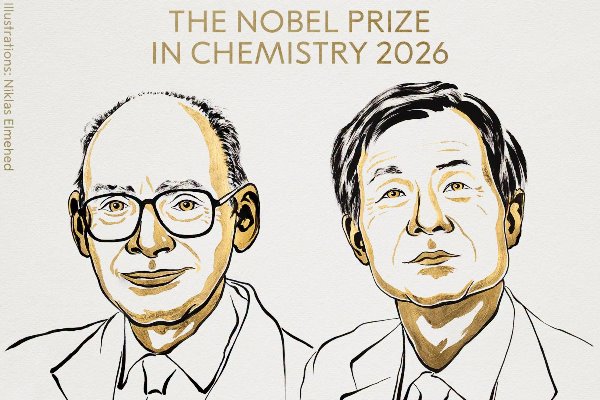
The 2026 Nobel Prize in Chemistry has been jointly awarded to French chemist Henri B. Kagan and Japanese chemist Kenso Soai for their research into the mechanisms behind “homochirality,” explaining why certain molecules in living organisms tend to adopt a single mirror-image structure. Their work not only contributes to our understanding of the chemistry of life but also provides an important technical foundation for drug synthesis.
Many organic molecules exist in two mirror-image structures known as enantiomers, much like a person’s left and right hands. Although they appear similar, they cannot be perfectly superimposed. Ordinary chemical reactions often produce both forms, yet biological systems show a clear preference. For example, the amino acids used by proteins predominantly adopt one of the two structures, resulting in the phenomenon known as homochirality. This difference can also affect how molecules interact with living organisms, making control over molecular stereochemistry an important issue in drug development.
In 1986, Kagan proposed a new chemical method demonstrating that reaction conditions could be adjusted to make one mirror-image structure form in significantly greater amounts than the other, providing a foundation for studying molecular asymmetry. Soai further investigated self-amplifying chemical reactions, proposing a related mechanism in 1995 and establishing an autocatalytic system in 2003 that allowed a single mirror-image form to maintain its dominance.
Their research also revealed the role of “non-linear effects” in asymmetric organic synthesis, showing how initially subtle structural differences can be progressively amplified through chemical reactions. This work has given scientists a more concrete chemical explanation for why life has developed such a high degree of molecular directional consistency.
The Nobel Committee for Chemistry noted that these findings are highly valuable for chemical research requiring precise control over molecular structures, particularly in drug synthesis. The research also provides new scientific clues for investigating the origin of life and how a preference for a single molecular mirror image may have first emerged in nature.
- 6 reads
Human Rights

Fostering a More Humane World: The 28th Eurasian Economic Summi

Conscience, Hope, and Action: Keys to Global Peace and Sustainability


Puppet Show I International Friendship Day 2020