Google AI Chip Launched Into Space, Paving the Way for Space-Based Data Centers
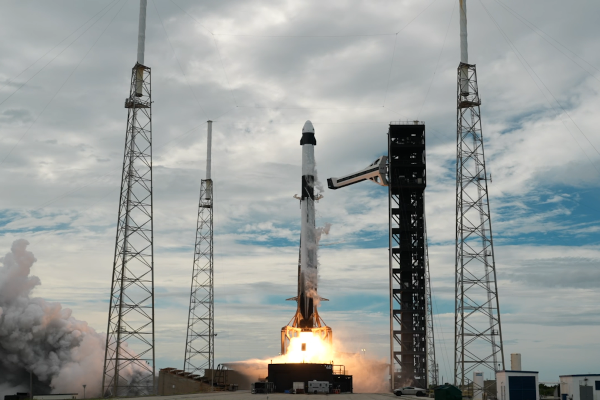
Google parent company Alphabet sent one of its AI chips into space on October 1. Through SpaceX’s Falcon 9 rocket, the company launched the “Transporter-18” mission, carrying a solar-powered experimental satellite equipped with a Tensor Processing Unit (TPU) into low Earth orbit. Google said it has successfully established communication with the satellite and that the equipment is operating as expected, marking the start of real-world testing for its vision of AI computing in space.
The mission is part of the “Suncatcher” project announced by Alphabet last year. Google aims to explore whether large-scale machine-learning computing facilities could be built in orbit and eventually connected through multiple satellites to form a distributed space-based computing network. Compared with ground-based data centers, satellites in low Earth orbit can receive sunlight for extended periods and theoretically access significantly greater solar energy, making them a potential alternative for AI computing infrastructure.
However, the main goal of this mission is not to immediately build a fully operational data center, but to determine whether TPUs can withstand the long-term conditions of space. Google has previously conducted AI workload tests on the ground. It will now monitor how the chips perform when exposed to cosmic radiation, extreme temperature fluctuations and the vacuum of space, generating data needed for future designs.
Google is not alone in exploring AI computing in space. SpaceX is also actively developing plans for orbital supercomputing and is expected to deploy related satellites in the coming years, highlighting efforts across the technology industry to extend AI’s enormous power and computing demands beyond Earth.
However, the concept still faces significant challenges before it can become commercially viable, including launch costs, equipment cooling, radiation protection, high-speed communication between satellites, and increasingly crowded orbits and space debris. The successful launch of the TPU is therefore only an initial demonstration. The key question will be whether the technology can eventually be scaled into a multi-satellite architecture, which could determine whether space-based data centers can become a practical reality.
- 62 reads
Human Rights
Fostering a More Humane World: The 28th Eurasian Economic Summi

Conscience, Hope, and Action: Keys to Global Peace and Sustainability
Puppet Show I International Friendship Day 2020