Roman Space Telescope Launches to Explore Dark Matter and Unravel the Mysteries of the Universe
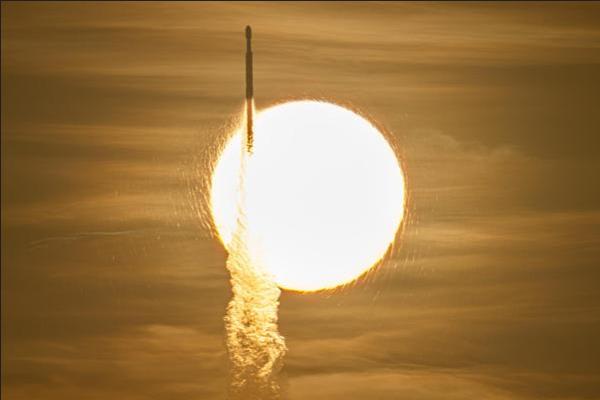
The latest flagship space telescope of the National Aeronautics and Space Administration (NASA), the Roman Space Telescope, was launched aboard Space Exploration Technologies Corp. (SpaceX)’s Falcon Heavy rocket from a launch site in Florida on the 30th local time, officially beginning its long-term mission to explore the universe. It will later travel to an observation point approximately 1.6 million kilometers from Earth.
The project has undergone more than a decade of development, with an investment of over US$4 billion. The telescope is named after American astronomer Nancy Grace Roman, who served as NASA’s first chief astronomer and was honored as the “Mother of Hubble” for her role in advancing the Hubble Space Telescope program.
One of the core missions of the Roman Space Telescope is to help scientists study dark matter and dark energy. These two mysterious components are believed to account for most of the universe, but they remain poorly understood. Through wide-field infrared observations, the scientific team will analyze the distribution and changes of large numbers of galaxies and supernovae, further tracing the history of the universe’s expansion.
Compared with the Hubble Space Telescope, the Roman Space Telescope has a field of view more than 100 times larger, while its survey efficiency can be approximately 1,000 times greater than Hubble’s. During its mission, it is expected to build a vast database of the universe, observing billions of galaxies and large numbers of stars, as well as searching for tens of thousands of exoplanets, some of which could become targets for more detailed follow-up studies.
In addition to its wide-field infrared camera, the Roman Space Telescope is equipped with a coronagraph that can block the intense light from stars, allowing scientists to attempt direct observations of dimmer planets orbiting nearby stars. The results will also be compared with observations from the European Space Agency’s (ESA) Euclid mission and the Vera C. Rubin Observatory in Chile.
Following its launch, the Roman Space Telescope will require several months of travel and instrument deployment. After reaching its observation point, it will undergo approximately three months of testing and is expected to begin scientific observations by the end of this year. NASA hopes that the mission will help build a more complete picture of the universe and provide new tests and clues for existing theories of physics.
- 35 reads
Human Rights

Fostering a More Humane World: The 28th Eurasian Economic Summi

Conscience, Hope, and Action: Keys to Global Peace and Sustainability


Puppet Show I International Friendship Day 2020