1:5 Million-Scale Lunar Geological Map: China Sets New Standard for Deep-Space Exploration
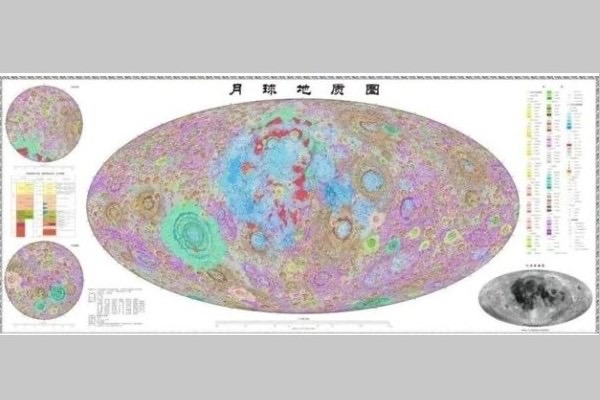
Chinese mainland research institutions have recently completed a new 1:5 million-scale geological atlas of the Moon, incorporating years of data accumulated from the Chang’e-1 through Chang’e-6 lunar exploration missions. The main map measures approximately 280 centimeters in length and 120 centimeters in height, and also includes detailed maps of the polar regions. The map precisely identifies more than 10,000 impact craters and over 80 large impact basins, while also distinguishing 14 types of geological structural features and 17 categories of rock composition.
The new study represents key advances in three major areas. First, it reorganizes the lunar geological timeline. Researchers precisely adjusted the starting points of ancient geological periods, including setting the beginning of the Aitkenian Period at 4.33 billion years ago, revising the Nectarian Period to 4.17 billion years ago, and adjusting the Imbrian Period to 3.92 billion years ago. It also provides the first more detailed classification of younger geological formations.
Second, the map updates the distribution of lunar materials. By using higher-resolution data to eliminate “spectral noise,” researchers found that the distribution of the strategic resource KREEP is more extensive than previously believed. Data from the Chang’e missions also provided the first confirmation of gabbroic anorthosite in the South Pole–Aitken Basin, offering new evidence for understanding the Moon’s deep interior structure.
Finally, the team established differentiated minimum mapping standards that balance large-scale visual presentation with microscopic scientific details. The map also adopts completely independent legend and color standards that have been certified by professional scientific societies. In the future, the system could serve as a reference framework for geological mapping of other celestial bodies, including Mars.
This landmark mapping achievement not only demonstrates a new understanding of the evolutionary history of extraterrestrial bodies, but will also provide valuable scientific support for future construction of lunar research bases, selection of landing sites, and deep-space exploration missions.
- 89 reads
Human Rights
Fostering a More Humane World: The 28th Eurasian Economic Summi

Conscience, Hope, and Action: Keys to Global Peace and Sustainability
Puppet Show I International Friendship Day 2020