Van Gogh’s Starry Night-Like Patterns: Scientists Discover New Phenomenon on the Sun’s Surface
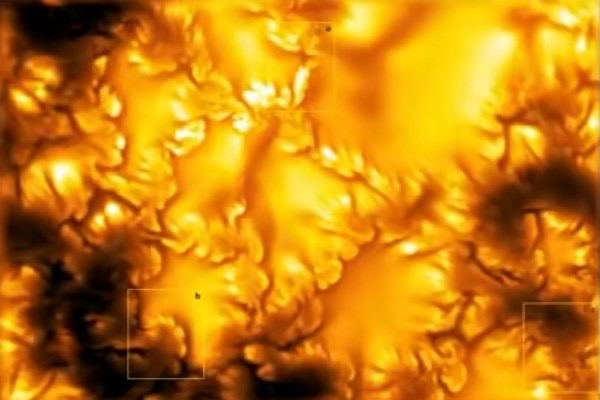
A U.S. research team used the Daniel K. Inouye Solar Telescope in Hawaii to capture the highest-resolution images yet of the Sun’s visible surface, directly observing for the first time tiny plasma vortices in the solar photosphere. The swirling, layered textures resemble the brushstrokes of Vincent van Gogh’s masterpiece The Starry Night, while also providing new clues about the mechanisms behind solar activity. The findings have been published in the international journal Nature.
Researchers said these swirling structures are distributed across the solar photosphere. Although tiny compared with the Sun itself, they range in size from about 19 to 170 kilometers. The smallest vortices are already close to the current resolution limit of telescopes. The observations show hot plasma forming waves and vortices where flows with different velocities meet, continuously evolving and releasing energy.
Scientists analyzed the observations and determined that this is the first direct confirmation of the Kelvin-Helmholtz instability (KHI) on the surface of a star. This physical phenomenon occurs when two fluids moving at different speeds slide past each other, producing spiral-shaped waves and vortices. Similar phenomena have previously been observed in Earth’s clouds and ocean waves, as well as in the atmospheres of planets such as Jupiter and Saturn. The Sun now provides the first direct evidence of the phenomenon occurring on a star.
The research team said these tiny vortices could hold the key to solving several major mysteries in solar physics, including why the solar corona is far hotter than the Sun’s surface, how magnetic fields rapidly accumulate and release energy, and what causes solar flares and coronal mass ejections. As the vortices continuously twist magnetic field lines, they may cause energy to rapidly accumulate and trigger powerful solar activity.
Researchers believe that incorporating such microscopic phenomena into solar models in the future could help improve space weather forecasting, which would be important for assessing risks to satellite operations, global positioning systems, power grids and communication systems. The team will next combine numerical simulations with additional observational data to further analyze how these plasma vortices transfer energy into the Sun’s upper atmosphere, with the goal of gaining a deeper understanding of stellar energy cycles and the evolution of magnetic fields.
- 104 reads
Human Rights
Fostering a More Humane World: The 28th Eurasian Economic Summi
Conscience, Hope, and Action: Keys to Global Peace and Sustainability
Puppet Show I International Friendship Day 2020