Hands-Free Dressing: South Korean and U.S. Researchers Develop Smart Wearable Technology
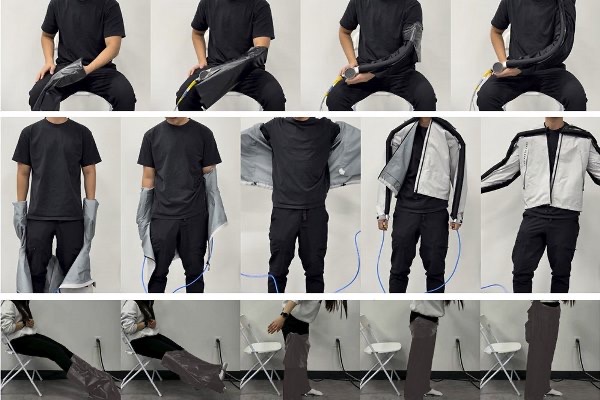
A joint research team from South Korea and the United States has developed a new automated dressing technology that enables users to put on clothing in about 10 seconds without pulling garments into place themselves or relying on assistance from others. The researchers believe the technology could improve daily living for older adults and people with disabilities, while also finding applications in environments that require rapid donning of protective gear, such as semiconductor cleanrooms, medical facilities, and disaster response operations.
The technology was developed by the Korea Advanced Institute of Science and Technology (KAIST) in collaboration with Stanford University and has been published in the journal IEEE Robotics and Automation Letters. The researchers integrated soft, flexible tubular structures into the garment, using air pressure to generate propulsion that guides the fabric smoothly along the outside of the body during the dressing process.
According to the team, the design was inspired by the growth mechanism of climbing vines. Rather than moving the entire device, the system continuously extends from its front end, allowing it to follow the contours of the human body. As it advances, it naturally turns the garment inside out and wraps the fabric around the wearer while minimizing friction against the skin.
The study’s first author said the entire dressing process takes approximately 10 seconds. The system can also tolerate slight body movements during operation, allowing users to move naturally without requiring complex control algorithms. The researchers added that, unlike conventional robotic arms, the soft robotic system contains no rigid frames, motors, or gears, enabling it to adapt to objects of different shapes, navigate confined spaces, and maintain effective movement on slippery, inclined, or adhesive surfaces.
Beyond assisting with daily care, the researchers believe the technology could be deployed in semiconductor manufacturing, healthcare, firefighting, and disaster relief, where workers need to put on protective clothing quickly and efficiently. By reducing preparation time and the need for manual assistance, the system could enhance operational efficiency. The team also noted that while recent advances in artificial intelligence have drawn much of the public’s attention to software, this research demonstrates that innovations in mechanical design remain equally essential for advancing intelligent technologies. Combined with AI systems in the future, the technology could pave the way for more efficient and practical smart wearable applications.
- 64 reads
Human Rights
Fostering a More Humane World: The 28th Eurasian Economic Summi

Conscience, Hope, and Action: Keys to Global Peace and Sustainability


Ringing FOWPAL’s Peace Bell for the World:Nobel Peace Prize Laureates’ Visions and Actions

Protecting the World’s Cultural Diversity for a Sustainable Future


Puppet Show I International Friendship Day 2020