Japan’s First Fully Liquid-Fueled Large Rocket, H3 No. 6, Successfully Lifts Off
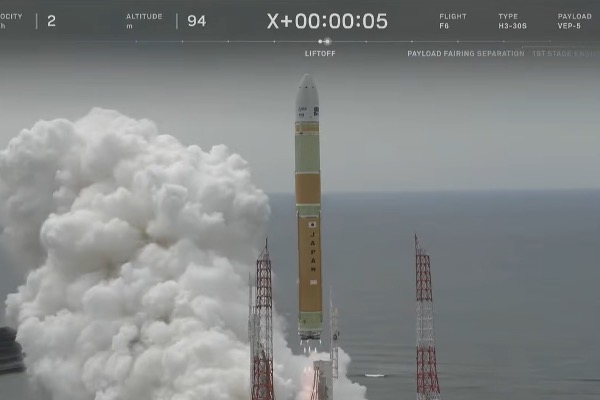
The next-generation flagship rocket H3, jointly developed by the Japan Aerospace Exploration Agency (JAXA) and Mitsubishi Heavy Industries, was successfully launched at 9:53 a.m. on June 12 from the Tanegashima Space Center. Approximately 15 to 16 minutes after liftoff, the rocket accurately entered its planned orbit at an altitude of about 580 kilometers. The achievement came only about six months after the failure of the H3 No. 8 mission in December last year.
Looking back at that setback, investigations revealed that the primary cause was inadequate bonding in the satellite mounting structure, which was damaged by impact forces during flight. The development team quickly implemented reinforcement measures using resin and other materials to address the defect. This successful return to space not only validates the effectiveness of those corrective actions but also marks a key milestone in restoring Japan’s credibility in the international aerospace community.
The No. 6 vehicle launched this time was a new experimental configuration that relied entirely on the first stage’s three newly developed LE-9 liquid-fueled engines, without the use of any solid rocket boosters. This was Japan’s first attempt to launch a large rocket powered solely by liquid fuel. Its success signifies that all three performance variants of the H3 series are now fully operational. Designed as a lower-cost version, the rocket reduces expenses by simplifying components and utilizing commercial off-the-shelf parts. Once mass production and routine operations are established, it is expected to fully achieve the program’s core objective of cutting launch costs by half compared with the previous H-IIA rocket, while primarily serving the deployment of government-operated Earth observation satellites weighing around four tons.
Instead of carrying a large commercial satellite, the No. 6 mission was equipped with a simulated payload developed by JAXA to collect flight data. It also carried six ultra-small satellites developed by universities and other organizations. These included Shiraito, developed by Shizuoka University to test space debris capture technologies, and Umitsubame (“Sea Swallow”), developed by Institute of Science Tokyo and equipped with a high-performance camera for applications such as ocean observation. After successfully reaching orbit, the rocket sequentially deployed all of these academic and technology-demonstration satellites, laying a solid foundation for Japan’s entry into the global low-Earth-orbit satellite launch market.
- 168 reads
Human Rights

Fostering a More Humane World: The 28th Eurasian Economic Summi

Conscience, Hope, and Action: Keys to Global Peace and Sustainability


Puppet Show I International Friendship Day 2020