Majorana 2 Unveiled Microsoft Achieves Another Major Breakthrough in Quantum Technology
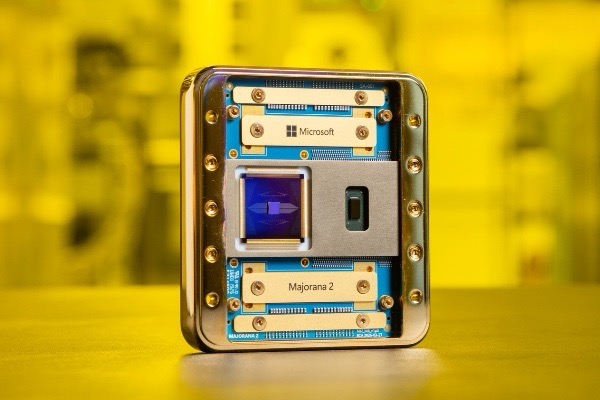
Microsoft’s Microsoft Build 2026 Developer Conference was held in San Francisco on June 3, where the company unveiled its next-generation topological quantum chip, Majorana 2, and announced a major breakthrough in quantum computing. Developed with the assistance of artificial intelligence, the chip improves qubit reliability by approximately 1,000 times compared with its predecessor, marking an important step toward scalable quantum computers.
In terms of design, Majorana 2 features a new materials stack and replaces the aluminum used in the first-generation chip with lead as the superconducting material. This change enhances resistance to environmental interference and improves quantum stability. According to Microsoft, the chip’s qubits can maintain their quantum state for an average of about 20 seconds, with some lasting up to one minute. Compared with traditional quantum systems whose coherence times are often measured in microseconds, this represents a substantial improvement in stability and a significant reduction in computational errors.
Compared with Majorana 1, the second-generation Majorana 2 delivers roughly a 1,000-fold improvement in quantum stability and reliability, bringing the technology closer to practical applications. Microsoft illustrated the magnitude of this advancement with a simple analogy: it is comparable to extending a smartphone’s battery life from requiring daily charging to lasting several years on a single charge, highlighting both the scale of the breakthrough and its potential value.
At the same event, Microsoft opened access to Microsoft Discovery, a platform that integrates AI agents, research reasoning engines, and enterprise-grade governance capabilities to support scientific research and industrial applications. Researchers can also access related tools through their GitHub Copilot accounts, accelerating scientific discovery and engineering development. Potential applications of quantum computing span healthcare, energy development, materials science, manufacturing, and food supply systems, helping solve highly complex problems that are difficult for conventional computers to address.
Microsoft also stated that it expects to deliver a commercially valuable and scalable quantum computer by the end of 2029, significantly ahead of its original roadmap. As quantum physics and artificial intelligence continue to converge, quantum computing is rapidly progressing from the experimental stage toward real-world deployment, positioning itself as a foundational pillar of next-generation computing architectures.
- 212 reads
Human Rights

Fostering a More Humane World: The 28th Eurasian Economic Summi

Conscience, Hope, and Action: Keys to Global Peace and Sustainability


Puppet Show I International Friendship Day 2020