NASA Advances Lunar Base Program as Robots and Uncrewed Equipment Prepare for Initial Moon Missions
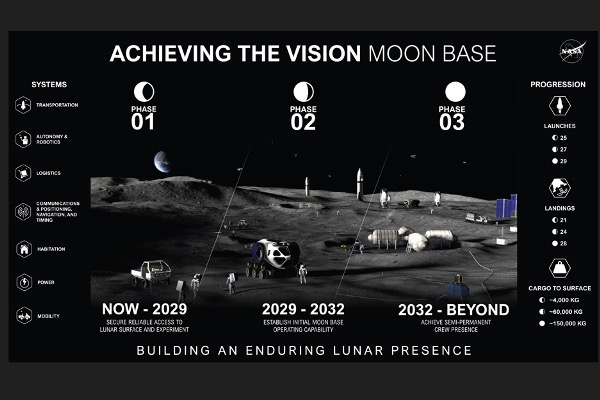
The National Aeronautics and Space Administration recently unveiled its latest blueprint for developing a lunar base, aiming to gradually establish humanity’s capability for long-term activity on the Moon through a series of phased missions. Beginning this year, unmanned equipment will first land in areas surrounding the Moon’s south pole to conduct terrain exploration and technology verification, paving the way for future long-duration astronaut missions.
In recent years, National Aeronautics and Space Administration has actively promoted the Artemis program. The goal is not only to return humans to the Moon, but also to build a sustainable lunar outpost that can serve as a critical hub for future deep-space exploration and eventual missions to Mars. According to the released plan, the overall project will be divided into three major phases.
The first phase is expected to continue through 2029, focusing primarily on unmanned missions and environmental surveys. Multiple launches and lunar landing operations are planned to transport exploration equipment, lunar rovers, and scientific instruments to the Moon’s surface, accumulating environmental data and operational experience in the lunar south polar region.
The second phase is scheduled to begin in 2029 and will focus on constructing power systems and semi-permanent facilities, including energy infrastructure and lunar surface mobility vehicles. National Aeronautics and Space Administration is also evaluating the use of locally sourced frozen water as a supply of drinking water and oxygen, reducing future dependence on Earth-based resupply missions. By the 2030s, the agency hopes to officially enter the third phase by establishing a long-term lunar base capable of supporting astronauts for extended stays, enabling prolonged scientific research and resource development on the Moon.
Among the missions planned for this year, National Aeronautics and Space Administration will collaborate with several private companies. An unmanned lunar lander built by Blue Origin could launch as early as this autumn, carrying scientific equipment to areas near the Moon’s south pole. In addition, Astrolab and Lunar Outpost are also participating in the development of lunar rovers, which may eventually be used for cargo transport, remote operations, and astronaut mobility.
National Aeronautics and Space Administration also plans to deploy hopping drones in future missions. Using short-distance jumping movements, these drones will collect high-resolution imagery and terrain data across rugged lunar surfaces, helping identify suitable areas for future human activity. Unlike the Apollo program of the 1960s and 1970s, which focused mainly on short-term lunar landings, the new initiative emphasizes long-term survival capabilities and infrastructure development, with the goal of gradually establishing a continuously operating lunar outpost.
As the United States accelerates its lunar ambitions, public attention has also turned toward a new era of space competition with China. National Aeronautics and Space Administration hopes that by deploying equipment early and validating critical technologies, it can maintain a leading position in future crewed lunar missions and deep-space exploration.
- 128 reads
Human Rights

Fostering a More Humane World: The 28th Eurasian Economic Summi

Conscience, Hope, and Action: Keys to Global Peace and Sustainability


Puppet Show I International Friendship Day 2020