Science
Boreal Forest Fires Could Release Deep Soil Carbon

The 2014 fires in Canada’s Northwest Territories burned more than 7 million acres of boreal forest, mainly comprised of cone-bearing trees like these jack pines. The fires released nearly 104 million tons of carbon into the atmosphere.
- Read more
- 333 reads
Amazon Rainforest Absorbing Less Carbon Than Expected

View from the top of a measurement tower, where researchers monitor critical forest canopy processes such as photosynthesis, plant water fluxes, leaf characteristics, and growth.
- Read more
- 348 reads
GRACE-FO Shows the Weight of Midwestern Floods

North America was almost entirely above its long-term average in mass in May 2019, due to Midwestern flooding, with the runoff raising the Great Lakes to record levels.
- Read more
- 340 reads
A battery-free sensor for underwater exploration

A battery-free underwater “piezoelectric” sensor invented by MIT researchers transmits data by absorbing or reflecting sound waves back to a receiver, where a reflected wave decodes a 1 bit and an absorbed wave decodes a 0 bit — and simultaneously stores energy.
- Read more
- 343 reads
NASA Gets a Rare Look at a Rocky Exoplanet's Surface

This artist's illustration depicts the exoplanet LHS 3844b, which is 1.3 times the mass of Earth and orbits an M dwarf star. The planet's surface may be covered mostly in dark lava rock, with no apparent atmosphere, according to observations by NASA's Spitzer Space Telescope.
- Read more
- 355 reads
Rocky, Earth-sized exoplanet is missing an atmosphere

Artist’s rendering of the surface of LHS 3844b, a planet that has been found to have no atmosphere.
- Read more
- 327 reads
Physicists design an experiment to pin down the origin of the elements

A new experiment designed by MIT physicists may help to pin down the rate at which huge, massive stars produce oxygen in the universe.
- Read more
- 335 reads
Scientists Observe the Explosion of a Monster Star Requiring New Supernova Mechanism

- Read more
- 328 reads
Automated Observing Network Inaugurated Telescope

SOAR telescope (left) and Gemini Observatory (right) The 4.1-meter SOAR telescope at Cerro Pachón in Chile, is the pathfinder facility for AEON and successfully completed its first observing night for the network.
- Read more
- 336 reads
Giant impact disrupted Jupiter’s core

An artist’s impression of a collision between young Jupiter and a massive planetary embryo.
- Read more
- 341 reads
Human Rights
Fostering a More Humane World: The 28th Eurasian Economic Summi

Conscience, Hope, and Action: Keys to Global Peace and Sustainability
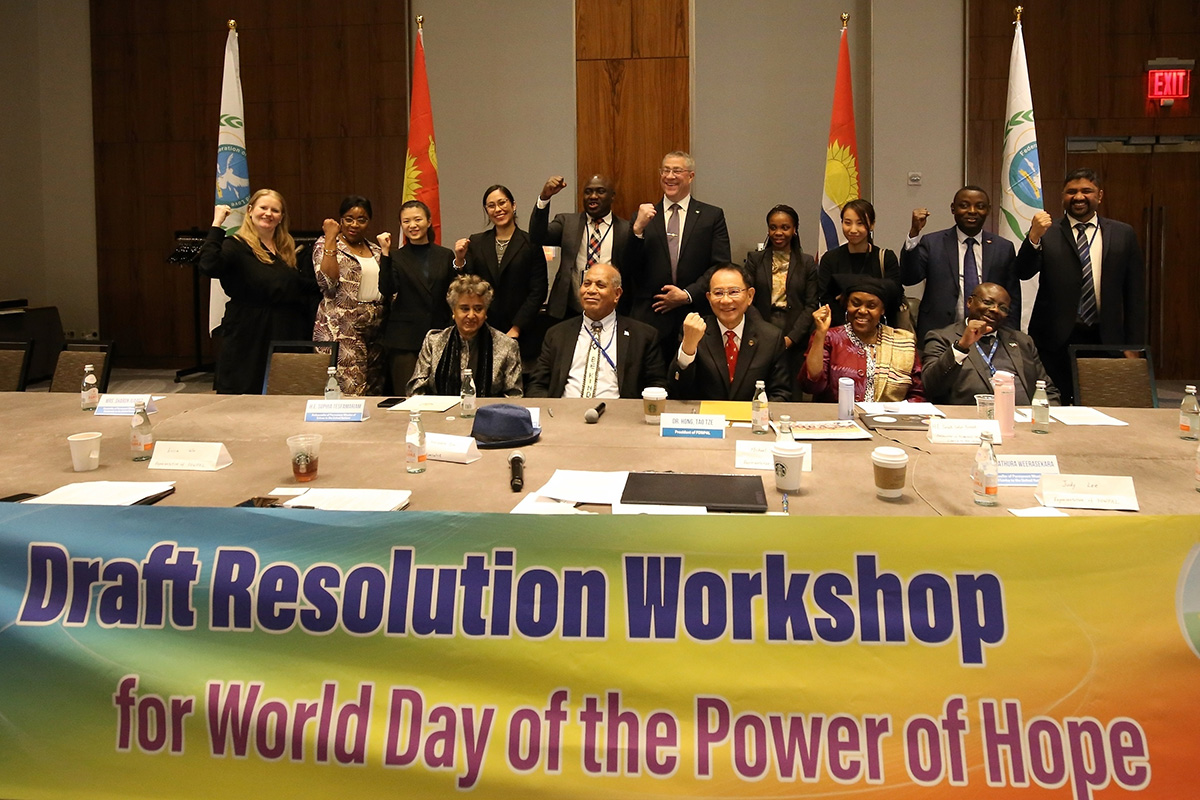

Ringing FOWPAL’s Peace Bell for the World:Nobel Peace Prize Laureates’ Visions and Actions

Protecting the World’s Cultural Diversity for a Sustainable Future


Puppet Show I International Friendship Day 2020