Science
TESS mission discovers massive ice giant

In our solar system, the “ice giants” Neptune and Uranus are far less dense than rocky Venus and Earth. But astrophysicists on NASA’s TESS mission have now found an exoplanet, TOI-849b, that appears to be 40 times more massive than Earth, yet just as dense. This illustration depicts the exoplanet, UCF-1.01. Like TOI-849b, this exoplanet also orbits close to a star and is like “hot Neptune."
- Read more
- 496 reads
Radar Points to Moon Being More Metallic Than Researchers Thought

This image based on data from NASA’s Lunar Reconnaissance Orbiter spacecraft shows the face of the Moon we see from Earth. The more we learn about our nearest neighbor, the more we begin to understand the Moon as a dynamic place with useful resources that could one day even support human presence.
- Read more
- 510 reads

NASA’s TESS Delivers New Insights Into an Ultrahot World

This illustration shows how planet KELT-9 b sees its host star. Over the course of a single orbit, the planet twice experiences cycles of heating and cooling caused by the star’s unusual pattern of surface temperatures. Between the star’s hot poles and cool equator, temperatures vary by about 1,500 F (800 C). This produces a “summer” when the planet faces a pole and a “winter” when it faces the cooler midsection. So every 36 hours, KELT-9 b experiences two summers and two winters.
- Read more
- 475 reads
Hungriest of Black Holes Among the Most Massive in the Universe

Hungriest of Black Holes Among the Most Massive in the Universe
- Read more
- 651 reads
A Cosmic Mystery: ESO Telescope Captures the Disappearance of a Massive Star

A Cosmic Mystery: ESO Telescope Captures the Disappearance of a Massive Star
- Read more
- 449 reads
The Beautiful Mess in Galaxy Cluster Abell 2255

The filamentary structures observed by LOFAR at the center of Abell 2255, here reported in red. These radio emissions are due to trails of particles and magnetic fields released by the galaxies during their motion inside the cluster
- Read more
- 471 reads
Array of Radio Telescopes Reveals Explosion on the Surface of a Hot Dead Star

The set of images obtained from the observations, starting 20 days after the discovery of the nova event and tracing the advance of the shock front for over six months.
- Read more
- 448 reads

Dance, Electron, Dance: Scientists Use Light to Choreograph Electronic Motion in 2D Materials

Microscope image of the TMD moiré superlattice device.
- Read more
- 471 reads
Human Rights
Fostering a More Humane World: The 28th Eurasian Economic Summi

Conscience, Hope, and Action: Keys to Global Peace and Sustainability
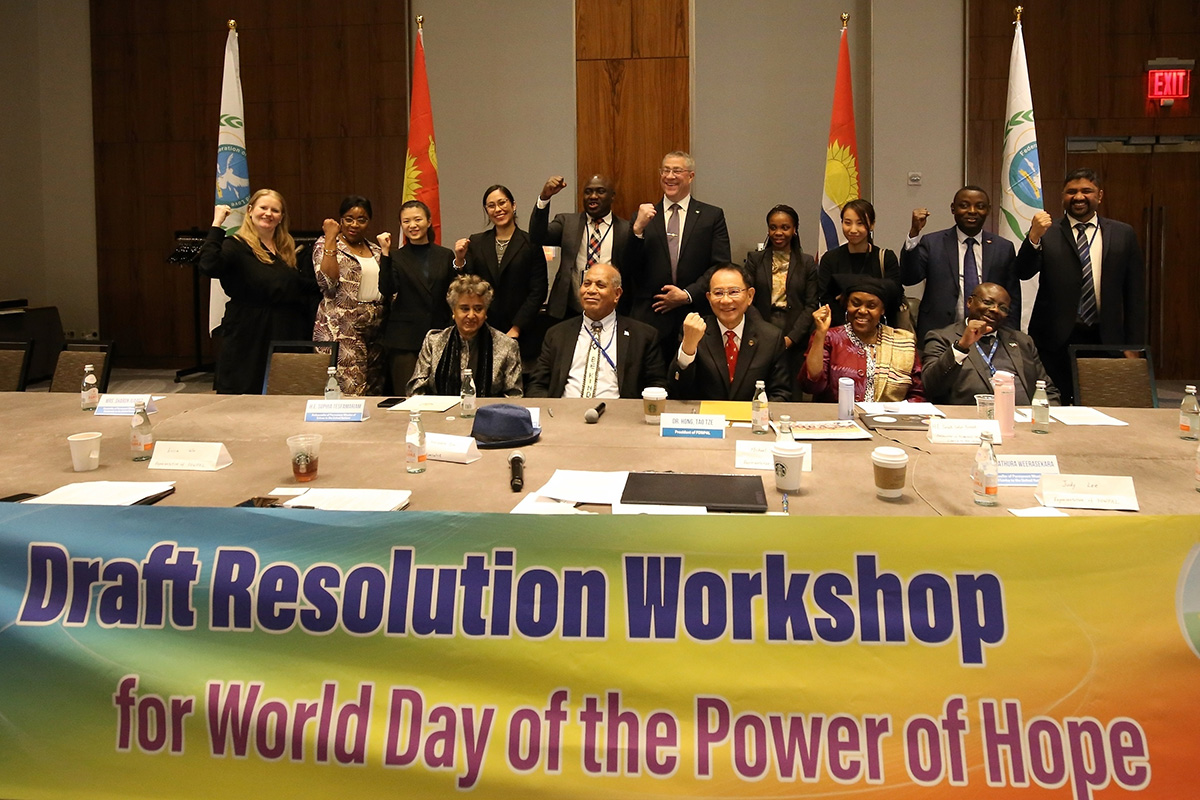

Ringing FOWPAL’s Peace Bell for the World:Nobel Peace Prize Laureates’ Visions and Actions

Protecting the World’s Cultural Diversity for a Sustainable Future


Puppet Show I International Friendship Day 2020