Trump Mediates as Rwanda and the Democratic Republic of the Congo Sign Peace Agreement, but Its Effectiveness Remains in Doubt
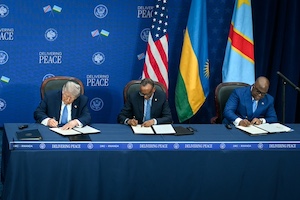
On December 4 in Washington, U.S. President Donald Trump, together with Democratic Republic of the Congo (DRC) President Félix Tshisekedi and Rwandan President Paul Kagame, signed a peace agreement and a critical-minerals cooperation plan. The initiative aims to end the decades-long conflict between the two countries and open a channel for the United States to access key rare-earth minerals. Despite strong U.S. backing, violence in eastern Congo has yet to subside, leaving the effectiveness of the agreement in question.
At the ceremony held at the U.S. Institute of Peace, Trump said the deal could be a “great miracle,” emphasizing that the U.S. would work with both countries on rare-metal extraction—an endeavor expected to generate significant business opportunities. Eastern DRC, a region plagued by frequent unrest, contains abundant critical materials needed for modern technologies such as electric vehicles. However, the two African leaders were more cautious: Kagame acknowledged that “there will certainly be ups and downs ahead,” while Tshisekedi described the agreement as “a new beginning, but a difficult path.”
The long-standing turmoil in eastern Congo has claimed hundreds of thousands of lives. Recently, clashes have intensified between the March 23 Movement (M23) rebel group and the Congolese government forces. The United Nations has accused Rwanda of supporting M23, raising further concerns over whether the peace agreement can truly bring an end to the conflict.
- 122 reads
Human Rights
Fostering a More Humane World: The 28th Eurasian Economic Summi
Conscience, Hope, and Action: Keys to Global Peace and Sustainability
Puppet Show I International Friendship Day 2020