Ariane 6 Makes Its Maiden Launch, Deploys 32 Amazon Satellites
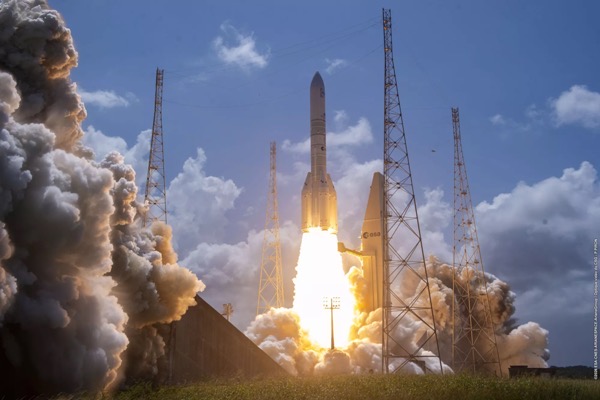
Europe’s new-generation heavy-lift launch vehicle, the Ariane 6 in its four-booster configuration, lifted off on the 12th local time from the Guiana Space Centre in Kourou, successfully delivering 32 Amazon low-Earth orbit communications satellites into near-Earth orbit. The mission marked its first commercial operation and a new milestone for Europe’s space transportation capabilities.
Designated mission VA267, this was the first flight of the Ariane 6 series using four solid rocket boosters. The rocket stands approximately 62 meters tall and is equipped with an extended payload fairing. About two hours after launch, the onboard satellites were sequentially deployed into an orbit at an altitude of around 465 kilometers. The mission team confirmed that all satellites are operating normally. The 32 satellites belong to Amazon’s low-Earth orbit broadband initiative, under which the company plans to build a large-scale satellite network to provide high-speed internet services worldwide. Under the contract, Europe will conduct multiple launches for the project, with this mission serving as the first collaboration between the two parties.
Since completing its maiden test flight in 2024, Ariane 6 has gradually increased its launch cadence. The four-booster variant can deliver more than 20 metric tons to low-Earth orbit—roughly twice the capacity of the two-booster version—and is regarded as a key asset for Europe in the commercial launch market. Executives at ArianeGroup stated that this success demonstrates Europe’s ability to independently undertake large-scale satellite deployments.
Global competition in the low-Earth orbit communications satellite sector is currently intense. Amazon is accelerating its efforts to catch up with established operators, as its number of satellites in orbit still lags behind major competitors. As a result, the company has procured launch services from multiple providers to speed up constellation deployment. With Ariane 6 successfully completing its debut commercial flight, Europe has added another achievement in the heavy-lift launch vehicle sector and paved the way for future large-scale satellite missions.
Although the mission has been described as a significant symbol of Europe’s aerospace autonomy, experts caution that without sufficient domestic orders, Europe’s heavy-lift rockets will still need to rely on overseas commercial clients to sustain launch frequency. How to strike a balance between market competition and strategic autonomy will be a key challenge for Europe’s space industry going forward.
- 207 reads
Human Rights

Fostering a More Humane World: The 28th Eurasian Economic Summi

Conscience, Hope, and Action: Keys to Global Peace and Sustainability


Puppet Show I International Friendship Day 2020