Archaeological Breakthrough! Indonesian Cave Hand Stencils Set a New Age Record
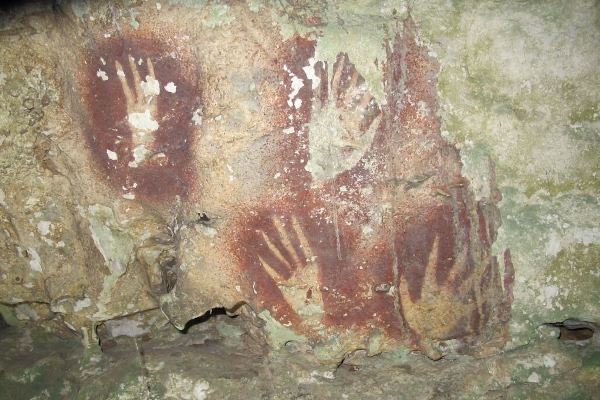
Archaeologists have recently announced a groundbreaking discovery. In a limestone cave on Muna Island in Indonesia’s Sulawesi Province, a research team has identified a set of ancient red hand stencils. Scientific analysis has confirmed that these images date back at least 67,800 years, making them potentially among the oldest known examples of human cave art in the world.
The study was conducted jointly by Indonesian and Australian scholars, including archaeologist Maxime Aubert of Griffith University in Australia and Indonesian researcher Adhi Agus Oktaviana. The team reported that these hand stencils had long been concealed beneath later depictions of animals and human figures and were only revealed during a recent re-examination of the cave walls.
According to the researchers, the hand images were created using a “negative” stencil technique. It is believed that prehistoric artists mixed ochre pigment with liquid and sprayed it around their hands pressed against the rock surface, leaving distinct outlines. Notably, some of the fingers appear deliberately elongated or modified into sharp, claw-like shapes. This stylistic feature has so far been observed only in Sulawesi, suggesting it may have held specific symbolic or ritual significance.
To determine the age of the artwork, the team analyzed calcite deposits that had formed over the surface of the paintings and applied uranium–thorium dating methods. The results indicate that the calcite formed at an extremely early time, thereby establishing a minimum age for the hand stencils. This finding not only pushes back the earliest known record of human artistic activity but also challenges the long-standing view that cave art originated in Europe.
Scholars note that the cave was used repeatedly across different periods, with some of the oldest images being overpainted by newer ones tens of thousands of years later, indicating its enduring cultural importance. More significantly, the discovery provides clear evidence that early modern humans (Homo sapiens) were present in the Indonesian archipelago at a very early date. It also offers crucial new insights into human migration routes toward Australia and the Sahul Shelf.
- 269 reads
Human Rights

Fostering a More Humane World: The 28th Eurasian Economic Summi

Conscience, Hope, and Action: Keys to Global Peace and Sustainability


Puppet Show I International Friendship Day 2020