Hidden Electricity in Martian Dust Storms: Perseverance Provides First Acoustic Evidence
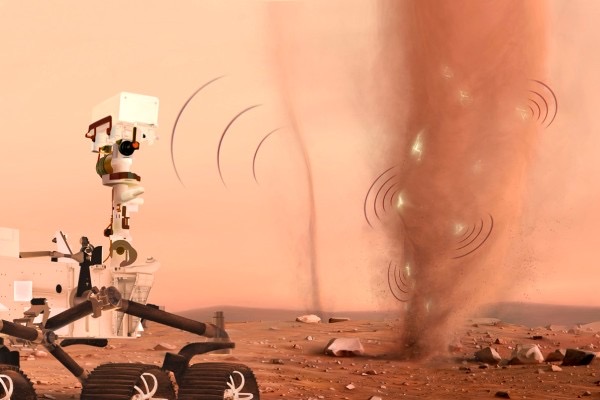
NASA has announced that, for the first time, the Perseverance rover has captured the sounds of electrical discharges generated by dust activity on Mars using its onboard microphone—providing unprecedented direct acoustic evidence that the Red Planet exhibits atmospheric electrical activity.
According to a new study published in Nature, researchers analyzed about 28 hours of audio recorded by Perseverance over two Martian years (roughly 3.76 Earth years) and identified 55 “mini discharge” events. These sounds mostly occurred during dust devils or the leading edges of dust storms and were characterized by short, crackling shock waves accompanied by simultaneous electromagnetic signals.
Baptiste Chide, a planetary scientist at the French National Centre for Scientific Research (CNRS) and lead author of the study, explained that although these “micro-shocks” carry only a tiny fraction of the energy of lightning on Earth, they show that friction between dust particles in Mars’s thin atmosphere can steadily accumulate electric charge and, under certain conditions, generate electric arcs a few millimeters to several centimeters long. He noted that these discharges may play a role in producing highly oxidative compounds on Mars and could help explain the rapid disappearance of methane detected on the planet’s surface.
The team found that most discharge events were closely associated with increasing wind speeds, with several recorded during dust storms occurring near the rover. They suggest that Mars’s low atmospheric pressure allows even small charge differences to trigger discharges, making miniature lightning a relatively common natural phenomenon on the planet.
This discovery places Mars among the few planets—alongside Earth, Jupiter, and Saturn—confirmed to have atmospheric electrical activity. Scientists say the finding not only reshapes our understanding of Martian weather and chemical processes but also provides valuable insights for future exploration missions.
- 243 reads
Human Rights
Fostering a More Humane World: The 28th Eurasian Economic Summi

Conscience, Hope, and Action: Keys to Global Peace and Sustainability

Puppet Show I International Friendship Day 2020